******************************************

WELCOME TO GOTHIC DIVINE!

THIS BLOG WAS CREATED IN NOVEMBER 2009 WITH THE GOAL OF GATHERING ALL INFORMATION POSSIBLE ABOUT GOTHIC CULTURE.

IT'S NOT A PROPER MAGAZINE SO DON'T TAKE US TOO SERIOUSLY.. :)

SO FAR MORE THAN 300 POSTS ABOUT MUSIC, FASHION, ART, MOVIES AND CURIOSITIES HAVE BEEN WRITTEN!

SUPPORT GOTHIC DIVINE BY COMMENTING THE POSTS, ANSWERING THE POLLS AND SUGGESTING OR SENDING US LINKS OF INTERESTING GOTH-RELATED TOPICS!


GOTHIC DIVINE... YOUR GOTH MAGAZINE!

NEW: Are you a goth artist, an illustrator, a musician, a band, a writer, a model or a photographer? Want to make yourself known among goth community online? To be featured or obtain a free interview in Gothic Divine Magazine it's easy: leave a comment in the guestbook with your name,your job or hobby (model, photographer etc.), your email address where we can contact you and a link to your website.
Incomplete "applications" won't be taken taken in consideration.

RECRUITING NEW COLLABORATORS FOR THIS BLOG!! Click on link below for more information

Followers

15 July 2013

Crows and Ravens

On a Google+ community about all things macabre I stumbled upon this image:


The face appearing is of E.A. Poe. Very artistic, isn't it? 
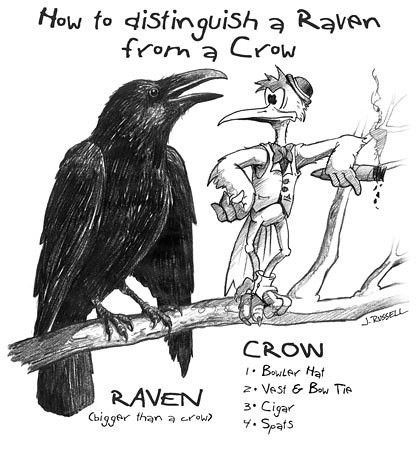
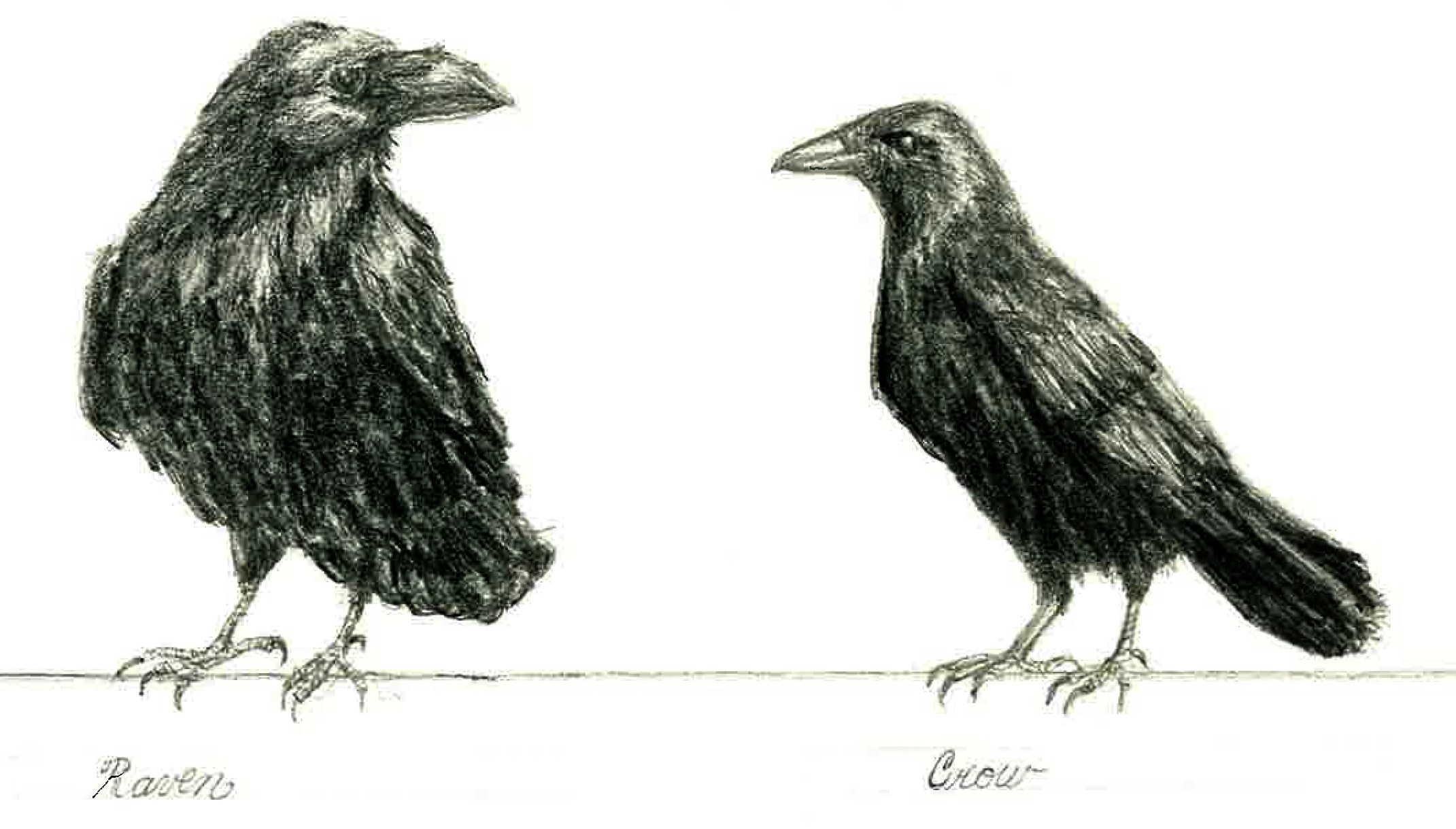
What inspired me to write this post though is not Mr. Poe but the crows used to shape the face. One of the people who replied to this image said those weren't crows but ravens. So far I never thought about the difference between crow and raven, actually because I thought there was no real difference but in the name. I thought it was just 2 popular ways to call the same bird and I believe I'm not the only one believing this. So just to make a little clarification for me and for all I repost you a very clear explanation of the difference between crows and ravens.


"The Common Raven ( Corvus corax ) is one of largest members of the crow family (the Thick-billed Raven, Corvus crassirostris , is the largest), corvidae, and order Passeriformes (perching /songbirds). The Corvidae family also includes birds such as crows, rooks, jackdaws, blue jays, magpies, and many others. Among all birds, ravens are said to be the most intelligent, showing capability for thought and problem solving, as well as tool making and using.

Ravens are omnivorous scavengers, meaning that they will eat, among other things, grain, bugs, berries, shellfish, small animals, eggs, and carrion. They have been known to act in concert with wolves or coyotes, leading them to prey or carrion. This is a win-win situation, since the raven is unable to penetrate the tough hide of the carrion with its beak, and the wolves don't have to search as hard for food. Because they eat carrion, ravens have long been associated with war and death, thus adding to the bad reputation they have acquired. In reality, these birds are very clever, curious, playful and some can even "talk". 

The Raven in Mythology 

With a reputation as a trickster and thief, harbinger of bad luck or of death, and unwitting giver of gifts, the raven is a part of mythology in almost every culture. This includes, but is not limited to, Native American, Scandinavian, European, Japanese, Chinese, Aborigine and Indian. In many cultures, the raven was originally white, but was turned black by a god who was displeased or from encountering smoke on one of his many escapades.

In Scandinavian mythology, the Norse god Odin has two ravens, Huginn (thought) and Muninn (memory) whom he would send out at the beginning of the day to gather information for him. 

In much Native American mythology, generally the Pacific Northwest, the raven is a creator. The first humans came from a pea plant that the bird had created, or he found them hiding in clam (male) and chiton (female) shells (Haida tribe). Messenger and occasional hero, albeit unintentionally, this is a mischievous trickster god, similar to the coyote. The raven is attributed to bringing the stars, moon and sun to the sky, mischievously stolen from a man who had kept them in a box for himself. 

The Celts associated the raven and crow with Morrigan, their goddess of death and war, she was said to be able to take the raven's shape.

The Tower of London: Ancient legend says that if the ravens that occupy the White Tower depart, the Tower and British Empire will fall. King Charles II almost got rid of the birds because his astronomer had complained about them. After hearing the legend, being superstitious he changed his mind, instead ordering that at least six ravens be kept at the tower at all times. Thus, there is always a regiment of ravens kept there, with their own keeper, the Ravenmaster. 

Thanks to the popularity of the Edgar Allan Poe poem, "The Raven," "Nevermore" is probably the word most associated with ravens.

Corvus even has its own constellation, in the southern sky near Virgo.


The Difference Between the Common Raven ( Corvus corax ) and the American/Common Crow (Corvus brachyrhynchos ) 

Though you can technically call ravens crows, belonging to the Corvus (crow) family as they do, you cannot call all crows ravens.

What are some differences between these two birds? The immediate difference between ravens and crows is size, the crow being approximately 1/3 smaller. The raven around the size of a red-tailed hawk (or a medium size full-grown cat), approximately 22 to 27 inches long, and the crow closer to the size of a pigeon, 17 to 18 inches long. 

Males and females of the species are about the same size and same color, young raven and crow mouths are pink-lined, the color changing from pink to black usually by the second year. Black from beak to feet, ravens and crows can both have iridescent sheens of blue, purple and green on their feathers, ravens more so than crows. Younger ravens can have a brownish-black sheen to their feathers. Rarely, ravens and crows have been born white; they can be either leucistic (less pigment) or true albino (no pigment). White ravens have been reported to live by Qualicum Beach, an island town in Brittish Columbia. 


Ravens are generally seen singly or in pairs, though young ravens stay with their parents for about six months. The more social crow tends to flock, the breeding pairs of crows at times allowing a couple yearlings to stay on and help with the next batch of chicks. Non-breeding birds of both species collect in like flocks, and share communal roosts. When finding food on a breeding pair's territory, a non-mated bird calls to fellow flock members, as the breeding pair is less likely to attempt to drive off a large number of intruders.

Ravens tend to avoid big cities, while crows can make their home there. Ravens have a deeper, more guttural call, and have a wider vocabulary of calls than crows. They are great at mimicking sounds, and some ravens have picked up human words, even changing the pitch of their call to reflect a human female or male voice.

source: emg-zine.com

09 July 2013

Sedlec Ossuary: hidden macabre treasure in the heart of Europe

For this summer I was planning to visit Czech Republic (located in central Europe) but unfortunately there's been a change of plans and I'm not going anymore. :( 

One the places in Czech Republic that was on my itinerary, beside visiting the wonderful gothic city of Prague, was a place called Kutna Hora which holds one of the world's most macabre places to visit: the Sedlec Ossuary
Now, I've seen catacombs, cemeteries, churches with corpses of priests displayed near the altar (in north Italy in the town of Monselice), but never such a monument to death!


The Sedlec Ossuary is a small Roman Catholic chapel, located beneath the Cemetery Church of All Saints in Sedlec, a suburb of Kutná Hora in the Czech Republic. The ossuary is estimated to contain the skeletons of between 40,000 and 70,000 people, whose bones have in many cases been artistically arranged to form decorations and furnishings for the chapel. The ossuary is among the most visited tourist attractions of the Czech Republic, attracting over 200,000 visitors yearly.


Four enormous bell-shaped mounds occupy the corners of the chapel. An enormous chandelier of bones, which contains at least one of every bone in the human body, hangs from the center of the nave with garlands of skulls draping the vault. Other works include piers and monstrances flanking the altar, a large Schwarzenberg coat of arms, and the signature of Rint, also executed in bone, on the wall near the entrance.


In 1278, Henry, the abbot of the Cistercian monastery in Sedlec, was sent to the Holy Land by King Otakar II of Bohemia. He returned with him a small amount of earth he had removed from Golgotha and sprinkled it over the abbey cemetery. The word of this pious act soon spread and the cemetery in Sedlec became a desirable burial site throughout Central Europe.

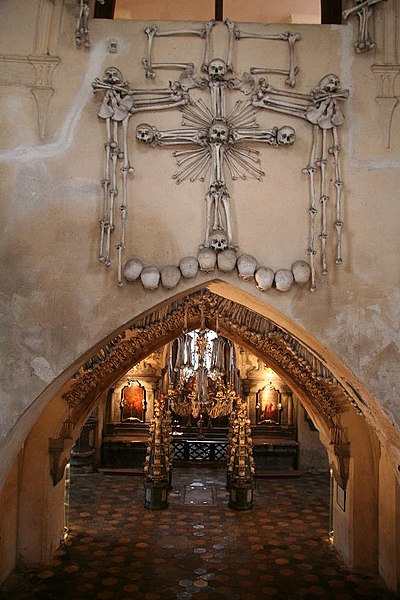
File:Sedlec Ossuary Entrance.jpg

In the mid 14th century, during the Black Death, and after the Hussite Wars in the early 15th century, many thousands were buried in the abbey cemetery, so it had to be greatly enlarged.

Around 1400, a Gothic church was built in the center of the cemetery with a vaulted upper level and a lower chapel to be used as an ossuary for the mass graves unearthed during construction, or simply slated for demolition to make room for new burials.
After 1511, the task of exhuming skeletons and stacking their bones in the chapel was given to a half-blind monk of the order.

File:SedlecInitials.JPG
The signature of F. Rint, the author of this macabre ossuary.
Between 1703 and 1710, a new entrance was constructed to support the front wall, which was leaning outward, and the upper chapel was rebuilt. This work, in the Czech Baroque style, was designed by Jan Santini Aichel.
In 1870, František Rint, a woodcarver, was employed by the Schwarzenberg family to put the bone heaps into order, yielding a macabre result.


The ossuary is a major plot device in the John Connolly novel "The Black Angel"
The ossuary is used as a location for the "Dungeons & Dragons" movie and the movie "Blood & Chocolate".
The ossuary was also featured in "Ripley's Believe it or Not" and is described by Cara Seymour in the final scene of the film "Adaptation".
The ossuary was also the influence for Dr. Satan's lair in the Rob Zombie film "House of 1000 Corpses".

File:Sedlec Ossuary Entrance.jpg
The entrance to the ossuary

03 July 2013

AYRIA: The Dark Side of Pop!


Ayria is a Canadian futurepop/synthpop musical project formed in early 2003 by Toronto's Jennifer Parkin following her departure from the influential futurepop and EBM band Epsilon Minus. The lighter, ethereal side of gothic, her work shows a collage of smooth textures and soft vocals over collisions of bass and driving beats, danceable and melodic with the darker elements and themes of electro-industrial music still present.


Parkin has stated in at least one interview that the name is a play on one of her favorite words, "aria", as in the melodic operatic form of singing and composition, but pronounced "area," because music has spatial properties.She once playfully suggested in her blog that AYRIA is an acronym for "Awesome, Yeah Really, I'm Awesome," but her emphasis on carefully constructed melody with ethereal vocals does recall the derivation of her stage name from classical music.


"With a fan base ranging from underground electro, industrial, goth, dance, and pop, people have referred to Ayria as the darker version of Lady Gaga, or the industrial Madonna. Jennifer Parkin has become a bit of an icon in the underground electronic and industrial music scene since starting Ayria in 2003, with her unique writing, singing and performing style and music with an in-your-face sonic approach that combines electro, synth-pop, industrial, 80’s dance, distorted gritty beats and synths, haunting melodies contrasted with angry distorted chanting all wrapped up with pop structures and catchy hooks."


I personally really like her cover of Depeche Mode's In Your Room :


And her remix of Angelspit's Grind:


Ayria Discography:

• Plastic Makes Perfect (CD) – May 24, 2013
• Plastic And Broken (Digital EP) – Feb 14, 2013
• Hearts For Bullets (CD) – 2008
• The Gun Song (EP) – 2008
• Flicker (CD) – 2005
• My Revenge On The World (EP) – 2005
• Debris (CD) – 2003

See more at: www.ayria.com


10 June 2013

When gothic literature and movies combine: "The Haunted Palace" and "Mary Reilly"

This weekend I watched two horror and gothic movies! I deeply suggest you to see them both. One is inspired by E.A. Poe and H.P. Lovecraft and the other is the classical Dr. Jekyll & Mr Hyde story but by another point of view.

The Haunted Palace is a 1963 horror film released by American International Pictures, starring Vincent Price, Lon Chaney Jr., and Debra Paget in a story about a village held in the grip of a cult. The film was directed by Roger Corman, and is often regarded as one in his series of eight films largely based on the works of American author Edgar Allan Poe. Although marketed as "Edgar Allan Poe's The Haunted Palace," the film actually derives its plot from The Case of Charles Dexter Ward, a novella by H. P. Lovecraft. The title, The Haunted Palace, is borrowed from a poem by Poe published in 1839 (the story of which was later incorporated into Poe's horror short story, The Fall of the House of Usher). Link to full movie:


"The Haunted Palace is a witches' brew of stories written by Edgar Allan Poe and H. P. Lovecraft--with the fine hand of sinister scenarist Charles Beaumont stirring the pot. Vincent Price plays two roles this time: A New England doctor burned as a sorcerer in 1745, and the dead man's great-grandson of 1855. Arriving in the village where his grandfather was killed, Price and his bride Debra Paget are shunned by the community. They are told that the mutant progeny of the "sorcerer"'s evil experiments are still roaming the countryside--with hulking manservant Lon Chaney Jr. a good example of these monstrosities. 

Vincent Leonard Price Jr. know for his roles in horror movies

The longer he stays in the family mansion, the more Price is taken over by the spirit of his ancestor. The result: The possessed Price, together with Chaney and a warlock assistant, set about to create a mutant race to overtake the world...

The film ends with the final verse of Poe's poem - '...While, like a ghastly rapid river, through the pale door, a hideous throng rush out forever and laugh - But smile no more'.

Other movie I saw yesterday night is Mary Reilly (1996).


Mary Reilly is a lonely servant in the home of Dr. Henry Jekyll, devoted to her position and her master. Slowly, a friendship between Mary and the doctor develops, which furthers into a growing attraction. However, the household is thrown into turmoil when the master announces he will be getting an assistant. The staff speculate on his employment, as he is never fully seen and remains a mystery...


31 May 2013

"I'm so goth I was born black" : the paleness issue

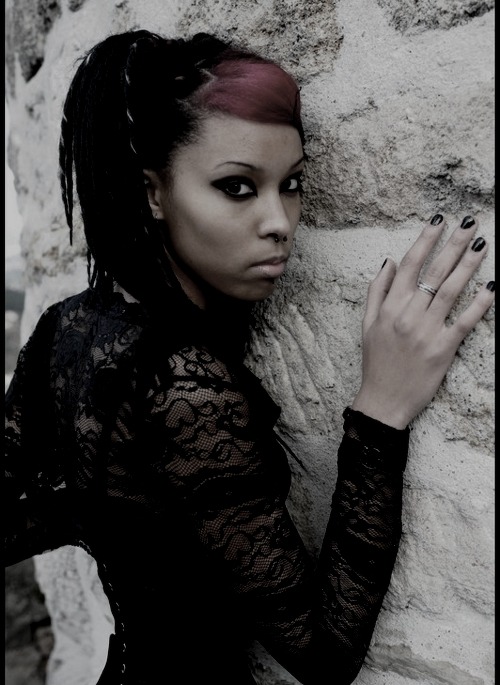
There have been other posts here in Gothic Divine Magazine about the "issue" -if so we want to call it- of the skin color in goth culture. Being I a dark-skinned goth too I feel this issue very close especially when people ignorantly tell me I'm not a true goth because I'm not white and pale like the moon..
On the internet by chance I found this very interesting and explicative article about this:

“I am so goth, I was born black.” 

the lovely Dysmantlinn from www.colormegoth.com
"While there’s still never been a black model on the cover of Gothic Beauty Magazine (in fact, having looked the past twelve years of covers up close, it’s clear that even models with brown eyes appear to be a rarity among the blue- and green-eyed cover ladies), and while most spooky fashion designers still prefer white models for their branding, a host of blogs dedicated to multicultural dark fashion are bringing greater visibility to the people that these venues ignore. Just on Tumblr, there’s Darque & Lovely, DarkSKIN, and Black Sheep Goths. On Facebook, groups such as Black/African American Goths foster lively discussion.

Of the Tumblr communities, Black Sheep focuses most specifically on people who are othered (providing a platform for “queer/fat/trans/non-binary/disabled/POC” goths), while DarkSKIN delves most deeply into different time periods (from Victorian photographs to seventies album covers to a friend’s most recently-uploaded snapshots), pop culture personalities taking a turn for the macabre (from Eartha Kitt singing “I want to be evil” to Aaliyah playing a sultry Anne Rice vampire) and media (from high-end fashion shoots to grainy self-portraits)

Black singer Aaliyah starred queen Akasha in  "Queen Of The Damned" movie inspired by omonymous Ann Rice's book about  vampires.

Many of the images come with empowering and, at times, defensive captions. It seems that even in 2012, some try to claim that the goth scene belongs to white people only. One caption on the Darque&Lovely blog, below an image of tattoo artist Roni Zulu, reads: “this is for the chicken-shit anon who said black people shouldn’t ‘do’ goth or punk. At certain points in history to be black in America was (still can be) a pretty gothic experience, to say the least.”

Is the goth scene unfriendly to people with dark skin? What do non-white goths think about the fetishization of paleness in the gothic subculture?

“The only time I experienced anything racial in the scene was at Death Guild [a San Francisco goth night],” says Shamika “Meeks” Baker, a San Francisco-based writer, artist and model. “A guy walked up to me, shouted ‘scuse me!’ and shoved me aside. Of couse, when I grabbed the back of his Fun Fur coat and yanked him back to demand an apology, he started screaming ‘get your black hands off of me!’ Happily, after I finished scaring him and turned around, I discovered several of my friends behind me and ready to back me up. [Other than that incident], I’ve found that the goth scene has been really welcoming and open.

“For me, the fetishization of paleness in beauty in general is very much a class issue as opposed to straight race,” says New York-based artist/maker Numidas Prasarn. The ‘ideal gothic beauty’ of being pale comes from this sense of otherness. When mainstream de mode is tanned beach babe, the pale contrast is taken up as the signifier of an Other that defensively puffs itself up. The problem is that it’s a microcosm that doesn’t necessary carry the sense of self-awareness to realize that it’s also othering people.

Amanda Tea - alternative model

Asha Beta, a sculptor, jewelry designer and musician currently living in Prescott, Arizona, comments on her invisibility within a community that borrows aesthetics from her cultural heritage:

The “traditional” ideal of the scene as the pale-faced, black-clad individual definitely never applied to me, but because of my instant and deep connection and attraction to the music and atmosphere of the scene I had to set that aside. I always felt that I was not perceived to be as attractive, as beautiful or even as “goth” as girls who were paler than me. I never attracted many suitors and I reconciled myself to never being able to approach the “gothic ideal of beauty” very early on, although I felt within myself that my personal way of being “goth” was very sincere and creative and very much true to what “goth” was all about. The one part of the scene that obviously made me uncomfortable was the military/Nazi/Aryan faction of it, although I understand that for many of those people it was a fetish or history obsession type of thing, and not necessarily based in racism.


Many of the aesthetics of goth culture are taken from my cultural heritage (Asian/East Indian/Middle Eastern, African/Egyptian/Voodoo/Haitian-Caribbean) so I still felt and feel strongly that my connection to it is natural and instinctive and powerful. It was achingly difficult to be a minority within the subculture I deeply loved because it’s within these that we find acceptance and understanding where the larger society rejects us. I was a loner within the scene just as I was in society. I found a personal solace and creative outlet, but I never found the community I was searching for. I am overjoyed to finally see our subcultures mirroring the multicultural quality of our world, and so glad to see the younger generations of subcultures finding and creating communities to connect with and support one another.


Meeks Baker agrees. “I love that more emerging blogs/sites focus on us dark-skinned gothy types. To be honest, I never really cared much for gothic beauty magazines because they didn’t really reflect my aesthetic, but I did still feel marginalized. To this day I am thrilled to see ethnic diversity represented in alternative culture.”

Posted by Nadya Lev on September 18th, 2012 on coilhouse.net


Plus, as I already stated in other posts, pale doesn't mean white. It means you have a color that lighter than your natural color and that gives you an insane look, almost cadaveric. I hope this post is helpful for those goths who feel outkast because of their non-stereotypical looks. :)

28 May 2013

The Witch Ball


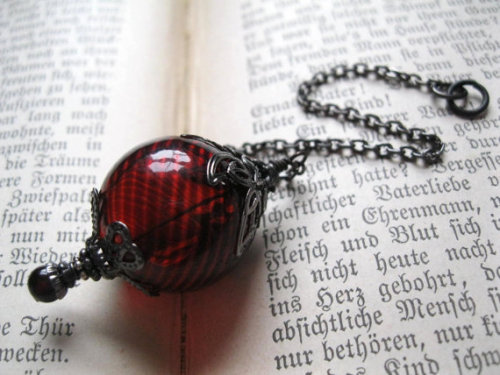
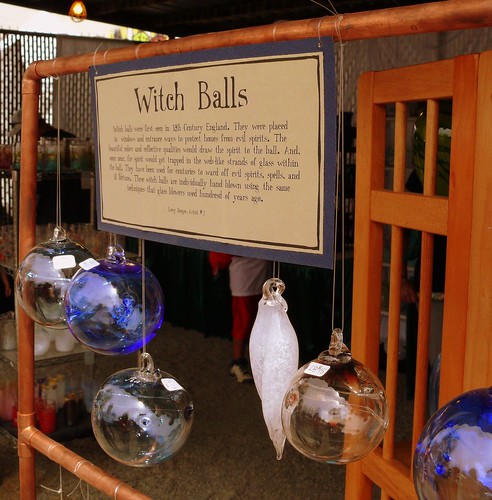
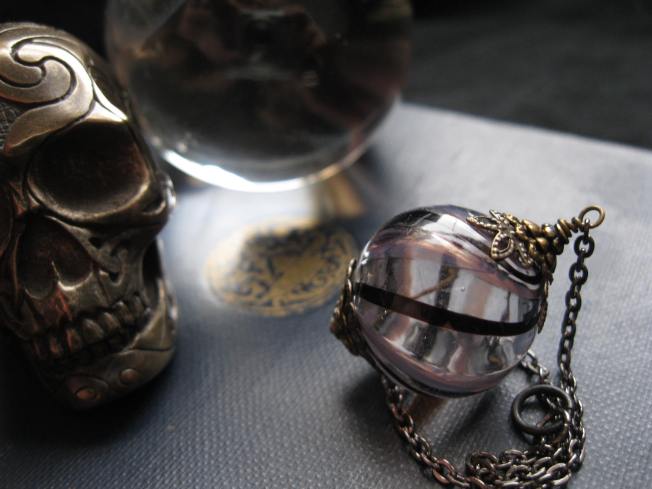
A witch ball is a hollow sphere of plain or stained glass hung in cottage windows in 18th century England to ward off evil spirits, witch's spells or ill fortune.

The witch ball originated among cultures where witches were considered a blessing and these witches would usually "enchant" the balls to enhance their potency against evils. Later, they were often posted on top of a vase or suspended by a cord (as from the mantelpiece or rafters) for a decorative effect. Witch balls appeared in America in the 19th century and are often found in gardens under the name gazing ball. However, gazing balls contain no strands within their interior.


According to folk tales, witch balls would entice evil spirits with their bright colours; the strands inside the ball would then capture the spirit and prevent it from escaping.
Witch balls sometimes measure as large as seven inches (18cm) in diameter. The witch ball is traditionally, but not always, green or blue in color and made from glass (others, however, are made of wood, grass, or twigs instead of glass). Some are decorated in enameled swirls and brilliant stripes of various colors. The gazing balls found in many of today's gardens are derived from the silvered witch balls that acted as convex mirrors, warding off evil by reflecting it away.


Because they look similar to the glass balls used on fishing nets, witch balls are often associated with sea superstitions and legends. In the Ozark Mountains, a witch ball is made from black hair that is rolled with beeswax into a hard round pellet about the size of a marble and is used in curses. In Ozark folklore, a witch that wants to kill someone will take this hair ball and throw it at the intended victim; it is said that when someone in the Ozarks is killed by a witch's curse, this witch ball is found near the body..


22 May 2013

La Santa Muerte


Santa Muerte is a sacred figure and feminine skeletal folk saint venerated primarily in Mexico and the United States. As a figure made holy by popular belief, the saint of death developed through syncretism between Mesoamerican indigenous and Spanish Catholic beliefs and practices. Santa Muerte, the name in Spanish, literally translates to "Saint Death" or "Holy Death". 

Since the pre-Columbian era Mexican culture has maintained a certain reverence towards death, which can be seen in the widespread commemoration of the syncretic Day of the Dead. Elements of that celebration include the use of skeletons to remind people of their mortality. The worship is condemned by the Catholic Church in Mexico as invalid, but it is firmly entrenched among Mexico’s lower working classes and various elements of society deemed as "outcasts".


Santa Muerte generally appears as a female skeletal figure, clad in a long robe and holding one or more objects, usually a scythe and a globe. Her robe can be of any color, as more specific images of the figure vary widely from devotee to devotee and according to the rite being performed or the petition being made. 

As the worship of Santa Muerte was clandestine until the 20th century, most prayers and other rites have been traditionally performed privately in the home. 

The number of believers in Santa Muerte has grown over the past ten to twenty years, to several million followers in Mexico, the United States, and parts of Central America. Santa Muerte has similar male counterparts in the Americas, such as the skeletal folk saints San La Muerte of Argentina and Rey (King) Pascual of Guatemala.


Santa Muerte is referred to by a number of monikers such as Señora de las Sombras ("Lady of the Shadows"), Señora Blanca ("White Lady"), Señora Negra ("Black Lady"), Niña Santa ("Holy Girl"), and La Flaca ("The Skinny Lady"). Some devotees call her Santa Sebastiana (St. Sebastienne) or Doña Bella Sebastiana ("Our Beautiful Lady Sebastienne"), since St. Sebastian was an early Christian martyr and is, among other things, patron saint of having a holy death. 


Images of Santa Muerte range from mass-produced articles sold in shops throughout Mexico and the U.S. to handcrafted effigies. Sizes vary immensely from small images held in one hand to those requiring a pickup truck to transport them. Some people even have the image tattooed on their bodies.


Her appearance varies, but she typically dons either long robes or dresses, covered from head to toe with only her face and hands showing. The robe or dress covers her skeletal figure like flesh covers the bones of the living. Both are said eventually to fall away. 

The most common image is of Saint Death in a robe, with a scythe in the right hand and the globe in the left. However, there are many variations on the color of the cloak, and on what Santa Muerte holds in her hands. Interpretations of the color of her robe and accoutrements vary as well.


The scythe can symbolize the cutting of negative energies or influences. Also, as a harvesting tool, it can symbolize hope and prosperity. Moreover, her scythe, which reflects her origins as the Grim Reapress ("la Parca" of medieval Spain), can represent the moment of death, when it is said to cut a silver thread. The scythe has a long handle, indicating that it can reach anywhere. 

The globe represents Death's dominion over the earth, and can be seen as a kind of a tomb to which we all return. Having the world in her hand also symbolizes vast power.
Other objects that can appear with an image of Santa Muerte include scales, an hourglass, an owl, and an oil lamp. The scales allude to equity, justice, and impartiality, as well as divine will. An hourglass indicates the time of life on earth. It also represents the belief that death is not the end, but rather the beginning of something new, as the hourglass can be turned to start over. The hourglass denotes Santa Muerte's relationship with time as well as with the worlds above and below. It also symbolizes patience. An owl symbolizes her ability to navigate the darkness and her wisdom. The owl is also said to act as a messenger. A lamp symbolizes intelligence and spirit, to light the way through the darkness of ignorance and doubt.


07 May 2013

Fairies and Butterflies

I don't know you but I'm very fascinated by legends and myths. Beside the ones about hauntings, I also like the ones about magical creatures. In the country I live apparently there have been - or still are! who knows!- some, from fairies to even dragons. For instance, there's a church with a giant bone hanging from the ceiling of the main hall which local legend says it belonged to a dragon who used to guard the lake in that area. (I will go check this out soon ^^)

Now I would like to share with you a place I went to visit last week. It's called Butterfly Arc and The Fairy Wood and it's a place where you can see hundreds of living butterflies of all kind from all over the world (including the butterfly you see on the top of this blog :P). They have created a natural enviroment so good that butterflies even live longer in there than in their natural habitat. At the entrance of the Butterfly Arc they show you the main species of these lovely creatures so that you get prepared to what you are going to see next.


Do you see anything familiar among these ones? eheh.. :)


These were just some of those exposed. To see them alive, you remain stunned by their beauty:


The butterfly coccoons


Two intruders!! There was also a little exposition of reptiles, spiders and insects inside the butterfly area.

When you exit the arc you find yourseld in the Fairy Wood. Right before the exit you find yourself in a little cavern where they show you the remainings of magical creatures like gnomes, goblins, fairy-like creatures or others. Along the road they put drawings of the magical creatures which are supposed to be found in that area and the description of their powers (good or evil). It is believed that fairies and butterflies are very connected to each other. Could a fairy be the next stage of a butterfly? :)


A rock labyrinth which was buit to make the place look more magical.

There was also a show many kinds of local witches and explanations of their supposed powers.
Inside the park there was also the cage with the nocturnal butterflies, unfortunately many were hidden behind the trees and the only pictures I could take:


I also had the chance to see one of the weirdest animals on earth...:S


LOL

There was also a fairy circle near the labyrinth. It's a natural occurring ring or arc of mushrooms which is believed to be be either created by fairies, witches or a gate to an elfic world.

RING6

"Fairies are magical beings who create the circles by dancing within them. Myths tell of mortal people entering fairy rings and suffering for it. Some believe that anyone stepping into an empty fairy ring will die young. Those violating fairy perimeters become invisible to those outside and may be unable leave the circle. The fairies force intruders to dance till exhausted, dead, or in the throes of madness.

The only safe way, according to some beliefs, to investigate a fairy ring is to run around it nine times only. A tenth lap would nullify the effect. Doing this allows the runner to hear the fairies dancing underground. It must be done under a full moon, and in the direction the sun travels during the day. It is also said that wearing a hat backwards confuses the fairies and stops them from doing the wearer any harm.

"Victorian society believed that fairies, elves and witches were all closely associated with one another, and malevolent toward humans. Scandinavian and Celtic traditions have it that fairy rings are caused by elves dancing, just as witches and fairies do. One Scottish woman claimed that the mushrooms were used as seats and tables for dining by the magical beings, while a Welsh girl claimed that the fungi were used as umbrellas."

"Fairy rings also occupy a prominent place in European folklore as the location of gateways into elfin kingdoms, or places where elves gather and dance. They are called "sorcerers' rings" in France, and "witches' rings" in German, where folk believe they are most active on 'Walpurgisnacht' – Hallowe'en to us. According to the local folklore, a fairy ring appears when a fairy, pixie, witch or elf appears."


Source: www.environmentalgraffiti.com


Related Posts Plugin for WordPress, Blogger...